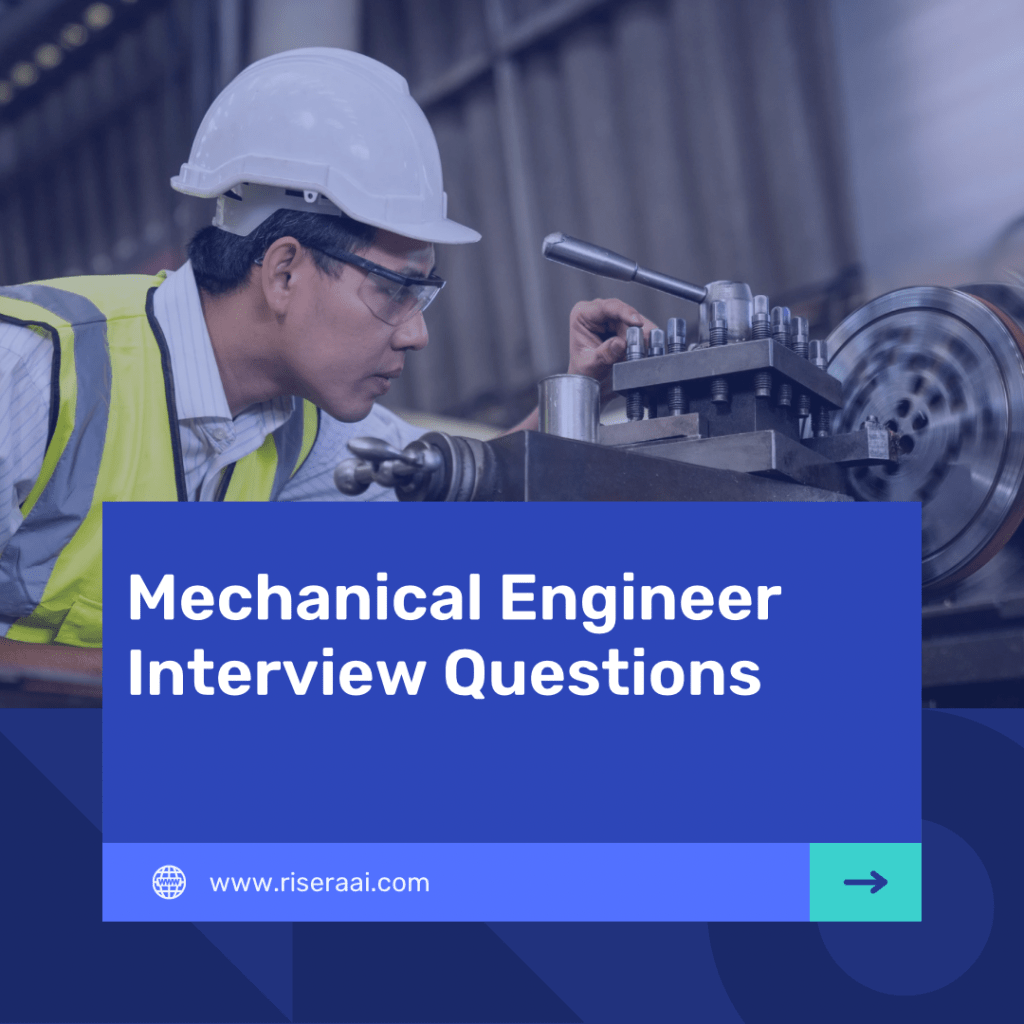
Mechanical engineering interviews are designed to evaluate more than your technical knowledge. Employers want to understand how you approach problem-solving, apply engineering principles, collaborate with cross-functional teams, and contribute to safe, efficient, and innovative projects.
Whether you’re applying for a role in manufacturing, oil and gas, automotive, aerospace, mining, energy, consulting, or product design, preparing for common interview questions can help you stand out from other candidates.
In this guide, you’ll find the most frequently asked mechanical engineer interview questions, learn what hiring managers are looking for, and review sample answers to help you prepare with confidence.
What Does a Mechanical Engineer Do?
Mechanical engineers design, analyze, manufacture, and improve mechanical systems. Depending on the industry, responsibilities may include:
- Designing mechanical components and equipment
- Performing engineering calculations and simulations
- Creating and reviewing technical drawings
- Conducting root cause analysis
- Improving manufacturing processes
- Ensuring compliance with engineering codes and standards
- Managing projects and budgets
- Supporting maintenance and reliability initiatives
- Collaborating with operations, production, and quality teams
- Implementing continuous improvement initiatives
Because the role combines technical expertise with communication and teamwork, interviews typically include both technical and behavioral questions.
Tell me about yourself.
Why interviewers ask this:
They want a concise overview of your education, engineering experience, and career goals.
Sample Answer
“I’m a Mechanical Engineer with over five years of experience supporting manufacturing and industrial operations. My background includes equipment design, reliability improvement, root cause analysis, project coordination, and continuous improvement initiatives. I enjoy solving complex engineering challenges while working collaboratively with cross-functional teams to improve safety, productivity, and operational performance.”
2. Why did you choose mechanical engineering?
This question helps interviewers understand your motivation and passion for the profession.
Sample Answer
“I’ve always enjoyed understanding how machines and systems work. Mechanical engineering allows me to combine analytical thinking with creativity to solve real-world problems, improve processes, and design solutions that create value for businesses and customers.”
3. Describe a challenging engineering problem you solved.
Behavioral questions are common in engineering interviews.
Use the STAR Method:
- Situation
- Task
- Action
- Result
Sample Answer
Situation: A production line experienced repeated equipment failures that caused unplanned downtime.
Task: I was responsible for identifying the root cause and implementing a long-term solution.
Action: I analyzed maintenance records, collaborated with operators, inspected equipment, and identified premature bearing wear caused by misalignment. After redesigning the alignment procedure and updating preventive maintenance schedules, equipment performance improved significantly.
Result: Equipment downtime was reduced, maintenance costs decreased, and production reliability improved.
4. What CAD software have you used?
Many employers want engineers who are comfortable with industry-standard design software.
Examples include:
- SolidWorks
- AutoCAD
- Autodesk Inventor
- CATIA
- Creo
- Siemens NX
Sample Answer
“I’ve primarily worked with SolidWorks and AutoCAD for component design, assemblies, and technical drawings. I’m comfortable learning new CAD platforms as needed and have experience collaborating with multidisciplinary engineering teams.”
5. How do you prioritize safety in your engineering work?
Safety is a core competency in engineering.
Sample Answer
“I always consider safety during the design and planning stages by following engineering standards, performing risk assessments, involving key stakeholders, and ensuring solutions meet regulatory requirements before implementation.”
6. Tell me about a time you worked on a cross-functional team.
Mechanical engineers regularly collaborate with production, maintenance, procurement, quality, and operations teams.
Sample Answer
“I recently worked on an equipment upgrade project involving production, electrical engineering, maintenance, and procurement. Regular communication, clearly defined responsibilities, and collaborative problem-solving helped us complete the project on schedule while minimizing production disruptions.”
7. How do you handle tight project deadlines?
Employers value engineers who can balance quality with efficiency.
Sample Answer
“I begin by identifying project priorities, developing a realistic schedule, and communicating regularly with stakeholders. If risks arise, I proactively adjust plans, reallocate resources where appropriate, and ensure quality standards are maintained throughout the project.”
8. Describe your experience with root cause analysis.
Problem-solving is one of the most important engineering competencies.
Sample Answer
“I’ve used tools fsuch as the 5 Whys, Fishbone Diagrams, Failure Mode and Effects Analysis (FMEA), and data analysis to identify root causes of equipment failures. I focus on implementing sustainable corrective actions rather than temporary fixes.”
9. What engineering standards are you familiar with?
Depending on the industry, employers may ask about standards such as:
- ASME
- ISO
- CSA
- ASTM
- API
- OSHA
- ANSI
Sample Answer
“My experience includes working with ASME design principles, ISO quality standards, and industry-specific engineering procedures. I always ensure designs and projects comply with applicable codes, company standards, and regulatory requirements.”
10. Why should we hire you?
This question allows you to summarize your strengths.
Sample Answer
“I bring a strong combination of technical expertise, analytical problem-solving, project coordination, and collaboration skills. I’m committed to continuous improvement and enjoy developing practical engineering solutions that improve safety, reliability, and operational performance.”
Common Mechanical Engineering Competencies Employers Assess
During interviews, hiring managers often evaluate candidates in the following areas:
- Engineering fundamentals
- Mechanical design
- Thermodynamics
- Fluid mechanics
- Materials science
- Manufacturing processes
- Root cause analysis
- Reliability engineering
- Continuous improvement
- CAD proficiency
- Project management
- Safety awareness
- Communication
- Teamwork
- Problem-solving
- Attention to detail
Preparing examples that demonstrate these competencies will help you answer behavioral and technical questions with confidence.
Tips for Passing a Mechanical Engineer Interview
- Carefully review the job description and identify the technical skills required.
- Refresh your knowledge of engineering fundamentals relevant to the role.
- Prepare STAR-format examples that highlight your technical and leadership abilities.
- Quantify your achievements whenever possible, such as reducing downtime, improving efficiency, lowering costs, or increasing production capacity.
- Be ready to discuss engineering software, design projects, maintenance strategies, and continuous improvement initiatives.
- Research the company’s products, operations, and engineering challenges.
- Prepare thoughtful questions for the interviewer about projects, technologies, and career development opportunities.
Prepare Smarter with RISERA AI
Every Mechanical Engineer position is unique. One employer may focus on equipment reliability, while another emphasizes product design, manufacturing, automation, or project engineering.
Practicing generic interview questions isn’t enough when employers expect answers tailored to their specific role and industry.
With RISERA AI, you can prepare for the exact position you’re applying for by uploading your resume and the job description. The platform analyzes your experience and generates personalized interview preparation based on the employer’s requirements.
RISERA AI helps you:
- Generate interview questions tailored to the job description
- Practice personalized answers based on your experience
- Build stronger STAR responses
- Identify the key technical and behavioral competencies employers are assessing
- Gain recruiter insights into what hiring managers expect
- Research the company before your interview
Whether you’re a recent mechanical engineering graduate or an experienced engineer pursuing your next opportunity, RISERA AI helps you prepare with confidence and showcase your strengths.
Start preparing today with RISERA AI at app.risera.ai.
Frequently Asked Questions
What questions are commonly asked in a Mechanical Engineer interview?
Interviewers typically ask about engineering fundamentals, design experience, CAD software, problem-solving, equipment reliability, safety, project management, teamwork, and behavioral scenarios based on your previous experience.
How should I prepare for a Mechanical Engineer interview?
Review the job description, refresh key engineering concepts, prepare STAR-based examples from past projects, research the company, and practice answering role-specific interview questions.
What technical skills do employers look for in Mechanical Engineers?
Employers often seek experience with CAD software, mechanical design, engineering calculations, manufacturing processes, root cause analysis, reliability engineering, project management, safety, and continuous improvement methodologies.
How important are behavioral interview questions?
Behavioral questions are just as important as technical questions. Employers want to understand how you solve problems, communicate with stakeholders, manage projects, and work effectively in team environments.
 Risera AI Interview Coach